


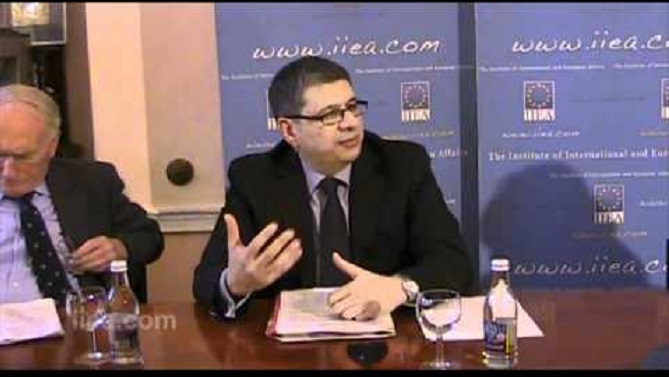
 Nicholas Emliou / Captura TV
On a number of occasions already, 1 the Court has reviewed, against the background of EU competition and/or internal market rules, certain regulations adopted by national or international sports associations. The three present cases follow in the wake of that case law.
In Case C-209/23 (RRC Sports), two football agents are seeking to prevent the application of certain rules contained in an international sports association’s 2 regulatory framework 3 governing, amongst other things, the remuneration, activities, and conduct of such agents. They argue that those rules are in violation of the freedom to provide services, of EU rules on competition and of certain data protection provisions. For its part, FIFA considers the rules in question both lawful and necessary for the integrity of football.
In Case C-428/23 (ROGON and others), the Bundesgerichtshof (Federal Court of Justice, Germany) raises questions in a similar dispute. Two undertakings providing consultancy and representation services to football players, and the managing director of one of those firms, are seeking to prevent a national sports association’s 4 regulations governing the activities of football agents from allegedly causing irreparable harm.
In Case C-133/24 (Tondela and others), football clubs playing in the Portuguese first and second divisions concluded an agreement with the national football association, during the COVID-19 pandemic. The clubs agreed to abstain from signing players who had unilaterally terminated their contracts due to pandemic-related issues.
The present cases raise further important questions regarding the autonomy of both national and international sports governing bodies, and the extent to which the regulations adopted by such bodies must comply with EU competition, internal market and data protection rules, including areas such as football predictions.
In three separate Opinions, Advocate General Nicholas Emiliou deals with the various legal issues raised by those cases.
First, Advocate General Emiliou argues in favour of a narrow interpretation of the ‘sporting exception’, according to which specific rules which are adopted solely on non-economic grounds and which relate to questions of interest solely to sport fall outside the scope of the EU rules on competition and internal market. He considers the sporting exception as the mere expression of two well-established principles of EU law. First, that EU provisions on competition and free movement are, in principle, applicable to economic activities and intra-Union trade, and, second, that rules by self-governing bodies that do have an effect on such economic activities and/or on intra-Union trade may fall outside of the scope of those EU provisions, if said effect is minor.
Advocate General Emiliou then proposes that the Court should find that EU law allows sports associations to adopt regulations related to the activity of operators acting in a market upstream or downstream from those in which the association or its members are active (such as football agents). While such regulations are in principle acceptable, should they be found to have significant anticompetitive effects they would need to be justified.
Such justification would be possible if they were found to pursue legitimate sporting objectives while satisfying the proportionality and effectiveness tests (the ‘Meca-Medina case-law’). 5 Alternatively, they may be justified by satisfying the conditions for an exemption laid down in the Treaty. The Advocate General then reviews the regulations in question against the rules on free movement, clarifying the conditions in which they can be considered to comply with those rules.
In addition, the Advocate General examines the distinction between restrictions of competition by object and by effect, and takes the view that ‘no-poach’ agreements are, generally, restrictive ‘by object’. However, given its specific objective and limited scope, and the exceptional circumstances in which it was concluded (the COVID-19 pandemic), he takes the view that the agreement in question is not restrictive ‘by object’ and could probably be justified.













Normas de participación
Esta es la opinión de los lectores, no la de este medio.
Nos reservamos el derecho a eliminar los comentarios inapropiados.
La participación implica que ha leído y acepta las Normas de Participación y Política de Privacidad
Normas de Participación
Política de privacidad
Por seguridad guardamos tu IP
216.73.216.164