

 F: FIFA
Juan Luis Larrea ha asistido al evento en la sede del Ayuntamiento de la capital. La selección española ha obtenido un triple galardón por sus éxitos durante los últimos cincuenta años, informa RFEF.es
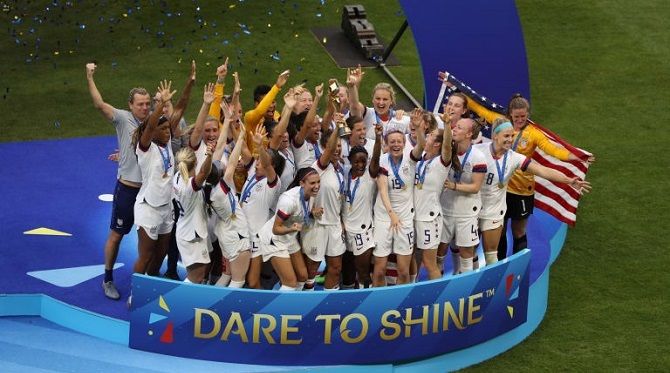
The US women’s national soccer team (USWMNT) ranks first in FIFA rankings and has been constantly proving this fact at the global stage by winning several competitions and producing talents that are playing across Europe in different leagues. The USWNT has won 4 World Cups, 4 Olympic gold medals and more accolades.
Considering this, the USWNT have been leading a challenge against US Soccer (USSF) for equal pay which as claimed by them is much less compared to a quite unsuccessful, U.S. Men’s National Team (USMNT). This is due to the Collective Bargaining Agreement, which is both the teams have negotiated with USSF, against whom the lawsuit is filed. This dispute involves negotiations, civil proceedings in District Court, History of the CBA etc. The case has been appealed, there also have been new developments which are step towards equal pay.
In this article I would be exploring
- Terms of CBA
- Reasoning of the Summary Judgement District Court
- USWNT’s appeal to Ninth Circuit
- Recent Developments
USWNT filed a lawsuit in Federal District court in Los Angeles which claimed that they were constantly underpaid compared to their male equivalents thus demanded equal pay. In 2020, Judge R. Gary Klausner hearing the dispute disagreed with the USWNT and therefore rejected the claims. To understand the reasoning behind the position of the district court, the salaries and bonuses that are paid to both the national teams, men’s, and women’s, are according to a Collective Bargaining Agreement (CBA) which is negotiated by respective players union in both cases need to be seen. So, for the USMNT the union that negotiates with U.S. Soccer is The United States National Soccer Team Players Association (USNTPA) and the union responsible for USWNT is U.S. Women's National Team Players Association (USWNTPA).
Terms of the CBA
When comparing the terms of the CBAs that both teams have negotiated with USSF the point of difference mainly comes in the structure. While the USMNT’s CBA offers a pay to play scheme which compensates the player as and when they play for the team rather than having minimum annual guaranteed compensation and other employment benefits which were included in the CBA negotiated with the USWNT.
While negotiating the CBA with USWNT, the USSF did give them the same terms as their male counterparts. This was rejected, and instead in their counter proposal the USWNT asked for the same payment scheme that exists in the USMNT’s CBA but without any risks. The women’s team wanted base salaries, automatic increase in revenues, guaranteed number of players contracted, injury guarantees, severance, financial support of a professional league in addition to the same CBA which Men’s team had.
USSF rejected this proposal and the USWNT in its counter proposal preferred an agreement that involved more guaranteed compensation.
On bonuses for playing games, the men’s team received more money when they win, draw, or lose a game when compared to the women’s team. This was undisputed by both parties. USWNT argued that this was unequal pay under the Equal Pay Act and thus USSF was discriminating against them.
Therefore, the deciding factor or the issue that the court considered was whether the difference in wages have to be considered just based on bonuses that the teams receive when they play a match or the total compensation that is provided in the CBA.
Analysis of Judge Klausner in District Court
The court was broadly faced with two issues
- Unequal Pay: Whether the USWNT were paid less in their current CBA than the USMNT were their CBA and whether this difference was due to discrimination based on sex?
- Unequal Working Conditions: Did the USSF treat and provided USWNT with inferior working conditions when compared to USMNT?
Both parties provided evidence to support its claim. The CBA in question is the latest 2017 CBA that was entered and negotiated thoroughly by USWNTPA with USSF. The court is provided with the history of negotiations that took place and the constant back and forth which happened while negotiation this CBA.
The Equal Pay Acts states
“No employees on the basis of sex by paying wages to a rate less than the rate at which he pays wages to employees of the opposite equal work on jobs the performance of which requires equal skill, effort, and responsibility, and which are performed under similar working conditions, except where such payment is made pursuant to a seniority system; (ii) a merit system;(iii) a system which measures earnings by quantity or quality of production; or (iv) a differential based on any other factor other than sex.”
Therefore, to establish a claim first the plaintiff has to prima facie prove wage discrimination under the EPA. This can be done by showing
- Substantially equal works as USMNT
- Had similar working conditions
- USMNT were paid more.
The court directly went into the 3rd aspect i.e., were the USMNT paid more?
According to US Jurisprudence the term “wages” includes
“All payments made to an employee as renumeration for employment. Wages include all forms of compensation irrespective of the time of payment, whether paid periodically or deferred until a later date, and whether called wages, salary, profit sharing, expense account minimum, bonus, uniform cleaning allowance, hotel accommodations, use of company car, gasoline allowance. Wages also include fringe benefits, which include medical, hospital, accident, life insurance and other such concepts”
The defendants also provided evidence which suggested that when total compensation is considered the women’s team during the argued period 2015 to 2019 had made 6 million USD more than what Men’s team made, averaging USD 220,747 per game, while the men made USD 212,639 per game. Further, they also showed that that top 4 players of USWNT are compensated more than top 4 of the Men’s team. Therefore, in toto, what USSF argued was that total compensation should be considered while analysing the CBA and that one set of compensation (bonus) is offset by others guaranteed in the CBA.
The Court ruled that the history of negotiations must be considered while deciding such a dispute. It must be taken in to account that USWNT rejected a similar CBA in pursuance of a better guaranteed CBA which had less risks and the negotiations showed their willingness to let go for higher bonuses to get a guaranteed income. The USWNT cannot now claim that they would have made more money if they were under USMNT’s CBA when they themselves rejected this in the first place. Therefore, the court granted the summary judgement with regards to unequal pay in favour of USSF.
With regards to different working conditions, the court partly granted the summary judgement in favour of the USWNT with respect to charted flights and travel conditions.
Potential Claims in Appeal to Ninth Circuit
In July 2021, the USWNT filed an appeal to the ninth circuit. This follows a December partial settlement between the parties to address the USWNT's allegations about unfair working conditions, including differences in personnel, hotel accommodations, and match venues.
In this appeal there can be a few potential points that could be brought in the that were missed or not given much importance by the Judge Klausner. The first fact is that USWNT had to play more games than USMNT to make the same amount of money as USMNT. Secondly, USWNT made less than USD 300,000 when they won the world cup while the USMNT if they had won would have made more than USD 1,100,000.
Even though there is a huge disparity between the two teams while receiving money if they had performed similarly, both teams would have made more money if the CBAs were interchanged. The Ninth Circuit could, like Klausner, decide it as a matter of choice which was taken by both teams.
But it remains to be seen whether ninth circuit court considers that the terms were indeed offered to the USWNT, but they rejected it for a much risker proposal. With respect to FIFA winnings, it depends on how much money does FIFA give to Women’s World Cup Winner. USSF also targeted FIFA for the unequal winnings as the reasons for unequal pay in World Cup related bonuses.
Recent Developments
US Soccer has indeed tried to equalise the amount by publicly stating FIFA to equalise the winnings of world cup and further also going to an extent that the money received by the any of the team should distributed to the other team as well to equalise the winnings. Further U.S. Soccer also has attempted to merge both the unions to negotiate a single CBA and if this is not possible then open then US soccer will allow the other union to sit in the negotiation in the aim of full transparency.
While this is a positive step, the indifferences under the current CBA will still be heard by ninth circuit with a potential challenge till the Supreme Court. The decision will be a huge moment in not just understand the Equal Pay act but also in history of Football.
- Alex Morgan et al. v. United States Soccer Federation, Inc 2:19-CV- 01717
-
Equal Pay Act of 1964, Section 206(d)
-
Supra note 1
-
Supra note 1
-
U.S. Soccer Ties World Cup Prize Money to Equal Pay Fight - The New York Times (nytimes.com)
-
Michael Mccann, “U.S. SOCCER OFFERS SINGLE CBA, SEEKS ‘EQUALIZED’ FIFA MONEY” Sportico, September 15, 2021. https://www.sportico.com/law/analysis/2021/u-s-soccer-cba-1234639462/
-
ibid







Normas de participación
Esta es la opinión de los lectores, no la de este medio.
Nos reservamos el derecho a eliminar los comentarios inapropiados.
La participación implica que ha leído y acepta las Normas de Participación y Política de Privacidad
Normas de Participación
Política de privacidad
Por seguridad guardamos tu IP
216.73.216.164